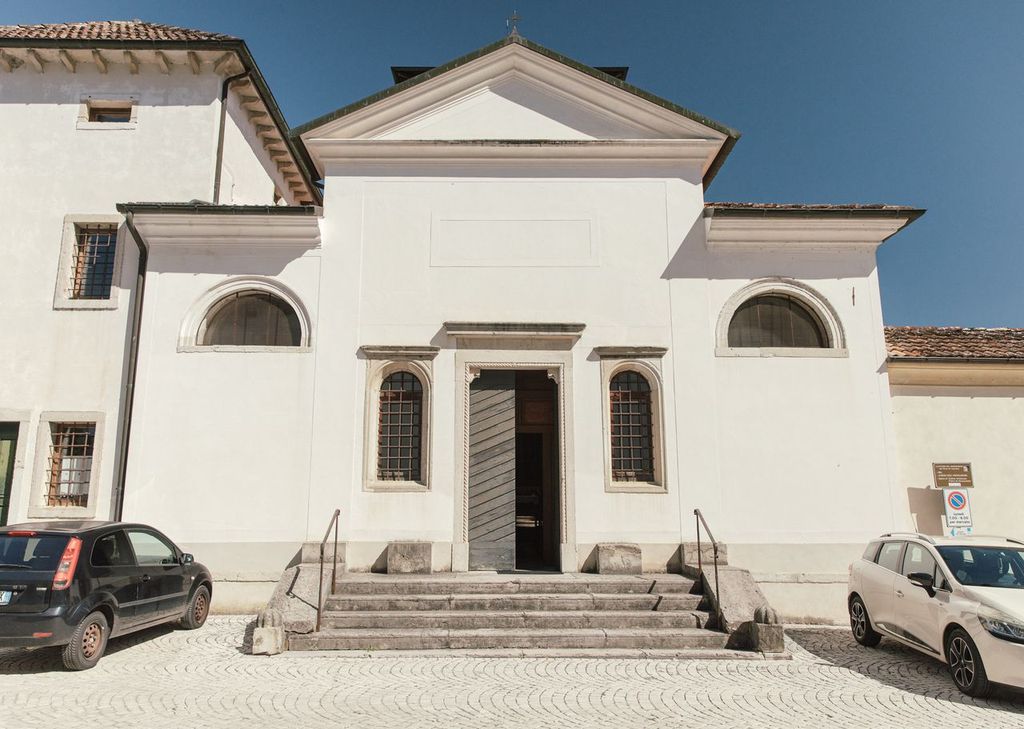
The ancient church of Mel, dedicated to Our Lady of Sorrows, was built between 1480 and 1490 with three naves and ten altars. It was an imposing church, but very little remains of the original building and of its bell tower.
In 1713, lightning struck the bell tower, causing minor damage, which was promptly repaired. In 1719, another bolt of lightning damaged the roof of the church and the organ pipes, but it was 17 April 1756 that sealed the fate of the original church: lightning struck the bell tower, setting it on fire, and its collapse severely damaged the church.
The bells were promptly recast and replaced, but they were requisitioned by the Germans during the First World War and melted down to make cannons. Only the smallest bell could be recovered. The current bells were purchased later by the people of Zumelle.
Its reconstruction had to wait until a project in the early 1800s: the apse and a small part of the central nave were preserved, and the altars were reduced to three.
Inside this church, it is possible to admire numerous valuable works of art: a baptismal font with a carved, painted and gilded wooden cover, dated 1481, attests to the central role of “parish church” that this church played in the Mel area. Of particular note is the tabernacle by Giovanni Antonio da Marcador, whose base recalls the iconography of the Resurrection; the tabernacle itself depicts the Risen Christ (surrounded by a sleeping guard, two angelic figures and four characters with scrolls), the cymatium is composed of two statues on the sides (the Virgin and the announcing angel) and, in the centre, a male figure with a scroll and God the Father giving his blessing.
An interesting fact is that the fountain and tabernacle were commissioned in 1465 by the parish priest Giorgio de Novamonte, who came from Albania (Novomonte can be identified with Novo Brdo, now in Kosovo) and who ran the church for more than forty years (he died in 1505).
It has been suggested that the guard lying beneath the Risen Christ may be Giorgio Castriota Scanderbeg (Gjergj Kastrioti Skënderbeu), an Albanian national hero of the Christian faith who was fighting against the Ottomans at that time. The ciborium would therefore be the only representation dedicated to Skanderbeg while he was still alive that has survived to this day.
The altar consists of a table with a 17th-century polychrome marble frontal and a carved, painted and gilded wooden altarpiece. The niche houses a 15th-century Vesperbild (piety). The church also houses a painting by Giovanni da Mel entitled Madonna with Child Enthroned and Saints Titian and Victor (1535), and another by Pietro Marescalchi entitled Madonna with Child Enthroned and Saints Peter the Apostle and John the Baptist.
Finally, in an urn at the beginning of the right aisle, the relics of Saint Faustus are preserved, which arrived in Mel in 1664, and on which the families of Zumelle swore to cease their conflicts and live in peace.